
On October 3, 2026, Aleph Alpha released Kolibri-1: a large language model (LLM) as an open-weight model. This means it uses trained weights that are freely downloadable and can run on your own hardware under the Apache 2.0 license. It was developed by the Heidelberg-based company Aleph Alpha and trained on computers in Germany and Finland. For companies that prioritize providers and solutions from the European legal jurisdiction, Kolibri-1 may therefore be an interesting option.
On October 12, Konfuzio conducted a small test run to determine whether the model can reliably read invoices, bank statements, and tax certificates, in order to obtain an initial practical assessment of the German model. The test was conducted on 17 German financial documents using the same Konfuzio pipeline as the best open-source model to date in the Konfuzio test set. This article describes what Kolibri-1 is and how a European model for document processing differs from other open models. At the end, we present our test results and highlight where Kolibri holds its own and where the model still falls short.
What is Kolibri-1?
- Origin: Developed by Aleph Alpha Research GmbH, released on October 3, 2026. The group is headquartered in Heidelberg.
- License: Apache 2.0 for the weights and configuration files. According to the model map, the code, architecture, and training methods are expressly excluded from the license.
- Structure: Mixture of Experts, a model consisting of many subnetworks, only a few of which are activated for each text segment (token). A total of 78 billion parameters, with about 3.46 billion active per token. The model is therefore memory-intensive but runs quickly.
- Languages: German and English. During the pre-training phase, with a total of 20 trillion tokens, the German portion accounted for about 23.9 percent, the English portion for 62.5 percent, and the code portion for 13.6 percent.
- Context: Up to 1,048,576 tokens; a maximum of 262,144 tokens is recommended.
- Reasoning: A delay option that can be enabled before the response, with settings for low, medium, and high. It can be configured using the setting
enable_thinking=falsecompletely switch off. - Training data: The source of the training data is documented. All data was checked against a blocklist containing more than 4.5 million URLs. This list is based, among other sources, on the European Commission’s Piracy Watch List. According to the model card, Aleph Alpha is also a signatory to the EU’s GPAI Code of Practice.
How does a European model differ when it comes to documents?
In document processing, the language model reads invoices, contracts, pay stubs, and bank statements—that is, data subject to the GDPR that, in many organizations, is not permitted to leave the company’s internal network. The comparable model Qwen3.5, which is also licensed under Apache 2.0, offers offline operation and a free license. What sets a European solution like Kolibri-1 apart are the legal jurisdiction of the provider and the training data, the documented data provenance, and the proportion of German texts in the training data. These advantages are not tied to a specific vendor; Kolibri-1 is the model against which others are measured. The four points in detail:
The data remains in-house
An open-source model runs on dedicated hardware, and during testing, Kolibri-1 ran entirely offline on a laptop. No document and no retrieved value ever left the machine. This provides the simplest answer to the question of data processing, because no third-party service provider is involved.
The article on this topic describes how the Data Protection Conference frames this question: AI and data protection. The costs associated with hardware and operations when running a system on your own servers are detailed in the article on On-Premise AI.
A license with no usage thresholds
The Apache 2.0 License grants a „perpetual, worldwide, non-exclusive, no-charge, royalty-free“ right of use. Commercial use is included; there are no thresholds for the number of users or revenue.
For companies, this has two consequences: No provider can later change the terms of use for the published weights, and no licensing issues remain unresolved during a due diligence review. The sample contract specifies that the license covers only the weights and configuration files; this is sufficient for in-house use.
German from the Ground Up
Aleph Alpha distinguishes itself in the Technical Blog for Publication based on models that learn German through translated English texts. Its own motto is: „bilingual by design, not an English model that has read some German.“ In addition, it features a tokenizer optimized for German—that is, the process of breaking down text into computational units. It represents German texts with fewer tokens, which saves on context and computation time.
Samuel Weinbach, co-founder and co-chief research officer, says in the press release: „We have tailored Kolibri specifically to the needs of German-language applications.“
A legal framework that fits your needs
According to the technology blog, the training took place „on infrastructure in Germany and Finland, under European and German law, with no foreign control.“ For a user in the EU, this means that the provider and the training location are subject to European law, and the place of operation is the user’s own home. With providers from the U.S. or China, data protection issues currently remain unresolved.
The press release also mentions an agreement with Cohere regarding a joint transatlantic venture, subject to regulatory approvals. This does not change the published weights or their licensing, as both are already in the hands of the users.
How the Test Was Structured
The test set is the same one that Konfuzio has used to date to compare open models: five types of German financial documents. These include bank statements, invoices, electronic invoices in ZUGFeRD format, tax certificates from banks, and securities statements. All are synthetically generated or public samples; none contain real customer or personal data. Two annual bank statements with several hundred transactions are excluded from the model comparison; the percentages and times refer to the remaining 17 documents.
For each field and each table cell, there is a manually verified target value—a total of 159 individual fields and 499 table cells. The task reflects everyday business operations: The pipeline passes the text from optical character recognition (OCR) and the extractor’s field instructions to the model. The model populates the fields—such as invoice number, amounts, and account holder—and reads each row of a transaction or line item table.
A value is considered correct if, after standardizing the spelling, it matches the target value. For table text, a tolerance is applied for line breaks resulting from text recognition. Both models ran on the same day on the same machine through the same Konfuzio pipeline:
- Hardware: A MacBook Pro with an M5 Pro and 64 GB of RAM, without a cloud service.
- Comparison model: Qwen3.5 35B-A3B from Alibaba, the open model with the best results so far in this test set.
- Quantization: Both models ran with reduced weight accuracy so that they would fit in memory. Kolibri-1 in the 3-bit version Q3_K_M is about 37.5 GB, and Qwen3.5 in the 4-bit version Q4_K_M is about 23 GB. Kolibri-1 was thus more heavily compressed; its values here tend to be on the low side rather than on the high side.
- Reasoning: Shut down at Kolibri-1; more on that below.
- Runtime environment: On the day of the test, Kolibri-1 was not yet able to run common tools such as Ollama. Instead, a community-modified version of llama.cpp was used.
The results
| Kolibri-1 (Aleph Alpha) | Qwen3.5 35B-A3B (Alibaba) | |
|---|---|---|
| Individual fields correct (159) | 97,5 % | 97,5 % |
| Table Cells Correct (499) | 96,8 % | 98,2 % |
| Documents with Abort (Reasoning Off) | 0 | 0 |
| Time for all 17 documents | 5.0 minutes | 9.4 minutes |
| Average time per document | about 18 seconds | about 33 seconds |
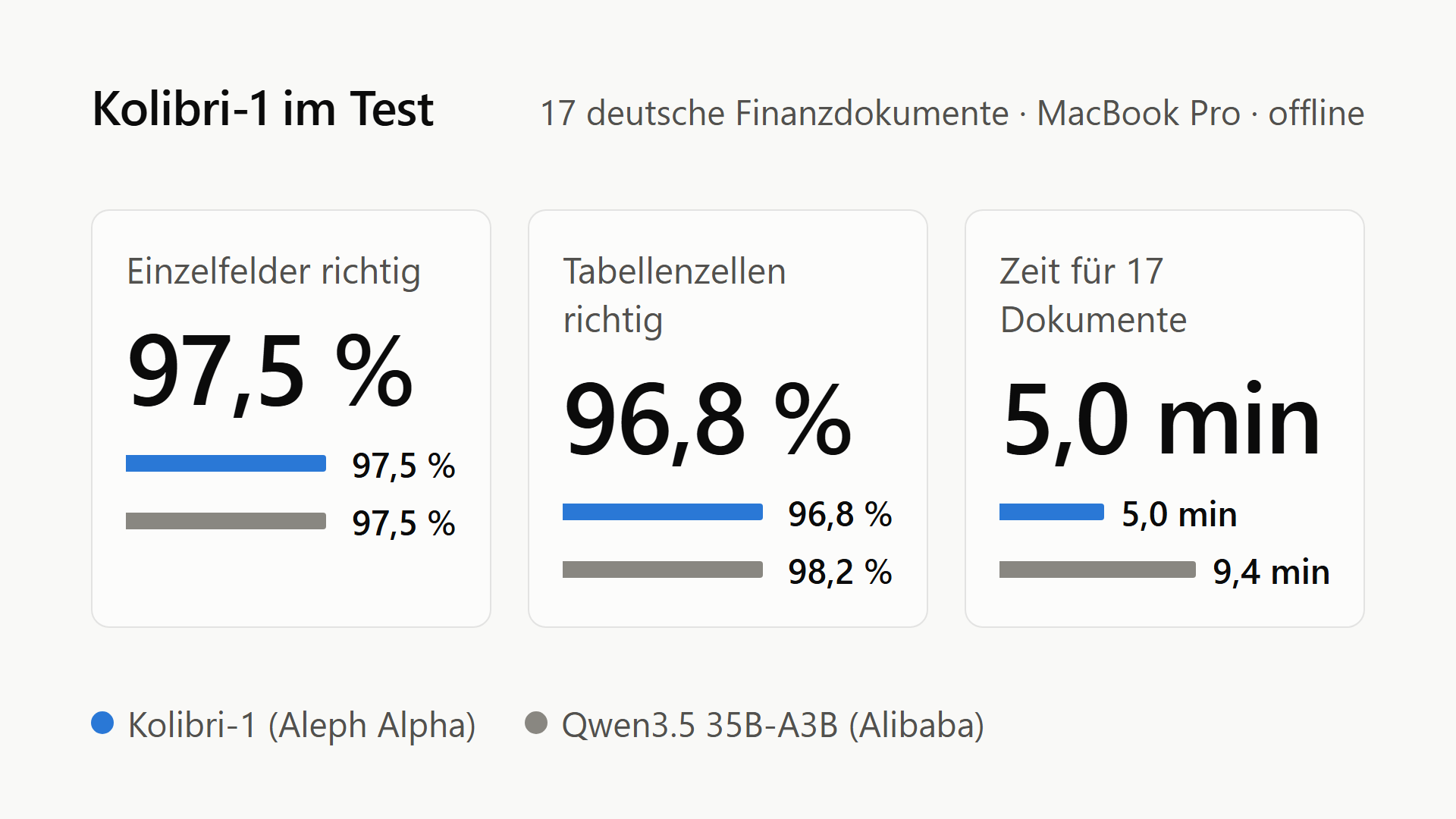
In terms of individual fields, both models performed equally well: each correctly read 155 out of 159 fields. For tables, Kolibri-1, at 96.8 percent, trails slightly behind Qwen3.5, which achieved 98.2 percent—a difference of seven cells out of 499. However, Kolibri-1 completed the entire test set in 5.0 minutes instead of 9.4 minutes. Simple, single-page documents such as tax statements were processed in about 10 seconds.
What the Test Shows
Same accuracy in about half the time
The 1.4 percentage point difference in the table cells corresponds to seven cells out of 499. Whether this is a difference between the models or simply variation could only be determined after running the test multiple times. The speed difference is more pronounced. The test does not reveal the cause: Both models activate only about three billion parameters per token. Possible causes include the other llama.cpp build, stronger quantization, and the tokenizer that is more dense for German—all three of which have not been tested.
In practice, this means that a document containing an incorrect cell must be reviewed by someone. The article on Human in the Loop.
Turn off reasoning
When reasoning was enabled, Kolibri-1 got stuck in a loop multiple times with short documents and exceeded the time limit. Without reasoning, every document was processed—about three times as fast, according to the test report. A model does not need to reason to extract fields because the answer is already in the document.
Long bank statements remain the limit
None of the models tested so far can read the two annual bank statements—12 and 14 pages long, with several hundred transactions—in their entirety in a single run. Kolibri-1 was the first to provide a portion of such a statement. According to Konfuzio, the solution is in the works: long tables must be extracted in sections, and this is currently being addressed.
Limitations of the Test
- Scope: 17 documents, all in German, all related to finance. Other document types and languages were not reviewed.
- Quantization: Both models ran in compressed form on a laptop. Full-precision versions running on a server were not tested; their results may differ.
- One run per model: Each number comes from a single run. Minor differences may be due to variation.
- Memory requirements: Kolibri-1 requires about 15 GB more RAM than the comparable model and barely fits on a 64-GB laptop. The model chart specifies that the uncompressed FP8 version, which is about 78 GB, requires at least two A100 cards (each with 80 GB), two H100 cards, or one H200 card.
- Tools: Support in Ollama and other tools was not yet available on the day of the test. This changes with each version; the values listed here reflect the status as of October 12, 2026.
What common benchmarks do and do not reveal about a model is discussed in the article on common LLM benchmarks. When it comes to document processing, nothing beats having your own test set with target values.
Conclusion: What the Test Reveals About a European Solution
Kolibri-1 reads German financial documents with nearly the same accuracy as the best open-source model on the Konfuzio test set—and about twice as fast. It runs under a license that allows commercial use without any thresholds on a single machine, and no documents need to leave the company. In this test set, it is the first model to combine both: a provider and training data located within the European legal jurisdiction, and performance on par with the best open-source model.
The limitations are the same as with all models: long tables that must be read section by section, and a toolset that still lags behind the model. Anyone who wants to know the values for their own documents needs their own test set. With 17 documents and verified target values, accuracy and speed could be reliably measured here.
In summary, it can be said that despite the test’s limitations, the initial signs are very positive. Kolibri-1 from Aleph Alpha is a strong European presence in the AI market and can be a genuine alternative, particularly for companies where compliance and data protection play a major role, since—unlike its international competitors—the provider is always bound by European law.
AThe source of the training data is documented. According to Press Release dated October 5, 2026 All data was checked against a blocklist containing more than 4.5 million URLs. This list is based, among other sources, on the European Commission’s Piracy Watch List. According to the model map, Aleph Alpha is also a signatory to the EU’s GPAI Code of Practice.
Kolibiri-1 can also be integrated into Konfuzio's solutions. Please feel free to contact us if you are interested or have any questions on this topic.

 EN
 DE
 ES
 FR