
Self-hosted
On-Premises
Use of Konfuzio on your servers
With the self-hosted option, you can operate Konfuzio directly on your own servers. This gives you full control over the software as well as the security and processing of your data - for maximum independence and data sovereignty.
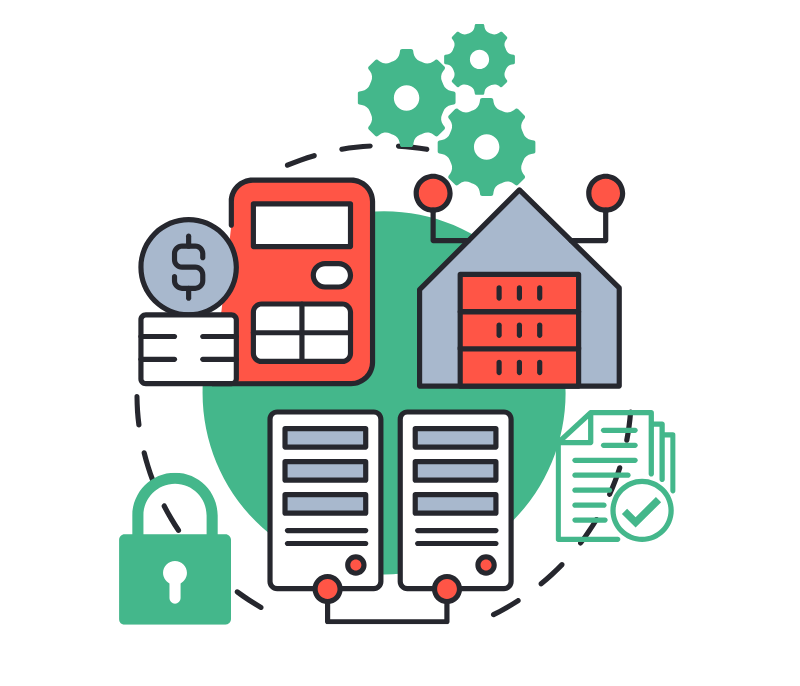






Control, data security & personal responsibility
Self-hosted offers
100%
Control over your DATA
Full control for your AI solution
Operation on own servers
By installing Konfuzio on your own servers, you take full control and responsibility for hosting the software. This makes you independent of the Konfuzio servers and allows you to implement your own rules and security standards.
Your data is stored exclusively on your servers and does not leave the company.
Data security according to your requirements
High compliance standards
Implementing your own rules and security standards ensures a high level of security and integrity for your data. As your data is stored and processed on your own servers, it never leaves your own IT environment and is therefore particularly protected.
This solution supports compliance and independence at the same time.
Own resources for smooth operation
Self-determined responsibility
Operating Konfuzio on your own servers offers maximum independence and full control. However, a powerful infrastructure and technical expertise are essential for this. Compared to the flexible cloud solution (SaaS), self-hosting requires more internal resources.
Which hosting option is better suited to your company's goals should therefore be decided with foresight.
Requirements & suitability
For whom the Hosting on your own servers suitable


For companies that process sensitive data with strict data protection requirements.
For companies that need complete control over their IT and data.
For companies that need secure applications that remain reliable even during Internet outages.
For companies that have the necessary infrastructure and resources.
Self-hosting in the cloud
Private Cloud for safety & flexibility
Konfuzio's private cloud offers companies an exclusive cloud infrastructure that enables them to meet the highest security and customization requirements. In contrast to the on-premises solution, you do not need your own server rooms; instead, operation is guaranteed via an exclusive cloud. Strict data protection guidelines and compliance standards are also met in the private cloud, as companies retain full control over their environment.

FAQ
Frequently Asked Questions
01.
Is Konfuzio compatible with our existing systems (e.g. ERP, CRM, DMS)?
Yes, Konfuzio supports flexible integration with almost all systems via our REST API (interface).
02.
How does the onboarding and training of the team take place?
When you sign a contract with Konfuzio, our experts will help you get started with customized workshops and training courses. These cover topics such as setting up projects, creating labels and label sets and training your own AI models.
03.
How many pages can the system process per hour?
Processing depends on the document complexity. In optimized environments, however, several thousand pages can be processed per hour, especially with parallel processing and a high-performance infrastructure.
04.
Are hybrid solutions consisting of self-hosting and cloud also possible?
Yes, our hybrid solutions combine the security and control of the private cloud with the cost efficiency and scalability of public clouds. This strategy allows you to manage resources flexibly, keeping critical applications and data in a secure environment and outsourcing less critical processes to the cloud
05.
Do you offer SLAs (Service Level Agreements) for availability?
Yes, Konfuzio provides SLAs. It is also possible to define individual SLAs. Talk to our experts about this.
06.
What is the difference between cloud and self-hosting?
With our cloud or SaaS solution, you run the Konfuzio software from our servers. With a self-hosted solution, you take responsibility and control on your own server. This has various advantages and disadvantages, which we explain in this Blog article have summarized.
 EN
EN  DE
DE  ES
ES  FR
FR