
The collection and analysis of data has made significant progress in recent years, and Retrieval Augmented Generation (RAG) is no exception. Future technological developments will further improve RAG models and expand their areas of application. In particular, the further development of natural language processing algorithms will increase the efficiency and accuracy of these systems. More advanced algorithms are expected in the future, which will not only optimize data retrieval, but also improve processing speed and adaptability to dynamic information sources. These advances could have a far-reaching impact on the way information is retrieved and generated, especially in an ever-changing digital environment.
What does RAG mean?
Retrieval Augmented Generation (RAG) is a method that combines search mechanisms with generative models to improve the quality of answers. By using RAG, systems can not only draw on existing knowledge, but also retrieve relevant information from extensive documents or data sources. This combination makes it possible to provide more precise and contextualized answers to complex questions instead of relying solely on the knowledge stored in the model.
Historically, RAG has evolved in response to the limitations of traditional natural language processing (NLP) approaches. While previous models were typically based on either rule-based algorithms or static data sets, RAG offers the flexibility to dynamically access up-to-date information. This evolution reflects the need to operate more efficiently in a rapidly changing information landscape and to generate precise answers from extensive, often unstructured data.
The introduction of RAG techniques has thus not only significantly increased performance in specific applications, but also created new opportunities for the development of interactive, intelligent systems. Today's RAG models are characterized by an improved ability to provide context-rich answers by combining optimal retrieval strategies while leveraging the strengths of generative models. These advances open up numerous fields of application, from automated customer service to supporting researchers in information retrieval.
Retrieval Augmented Generation - RAG for short - is a method in the artificial intelligence (KI) and the natural language processing, which aims to improve the performance of LLMs by integrating external retrieval systems. The technique allows retrieval of data from external sources, e.g., organizational corpora or document databases, and is used to enrich the data used to condition the language model (LLM). prompts.
How does RAG use LLMs?
Retrieval Augmented Generation utilizes the power of large language models, such as GPT-4, in conjunction with external retrieval or search mechanisms. Rather than relying solely on the model's internal knowledge, RAG queries an external data set, typically a corpus of documents, to retrieve relevant information. This retrieved data is then used to generate a contextualized response.
Comparison of RAG to traditional NLP methods
The efficiency of RAG compared to traditional NLP methods is significant. While conventional systems are often based on pre-trained models that are limited to static data sets, RAG provides access to up-to-date and diverse information. A RAG system can retrieve relevant data and process it in real time, making responses to user queries more accurate and relevant.
The dynamic nature of RAG increases the relevance of the answers by providing access to current sources of information.
The integration of retrieval mechanisms maximizes the relevance of answers by integrating up-to-date content from extensive data sources. This is particularly beneficial in rapidly evolving fields such as healthcare, law or journalism, where up-to-date information is crucial for informed decision-making and analysis.
RAG integration with other AI systems
An important aspect of the future development of RAG is the possibility of integrating this technology with other AI systems. The synergy between RAG and existing systems such as machine learning, image processing or generative models opens up new perspectives for applications in various sectors. The multimodality of these approaches could enable RAG models to process not only text but also images and other data formats simultaneously. This integration could be particularly beneficial in areas such as healthcare, where visual data and text need to be coordinated to support comprehensive analysis and decision-making.
RAG applications and AI ethics
With the increasing implementation of RAG systems in various industries, ethical considerations must also be taken into account in their development and application. Responsibility in the handling of sensitive data is of paramount importance. It should be ensured that the sources of information used do not promote discriminatory or unjustified content. In addition, the risk of bias in the algorithms must also be minimized in order to achieve fair and equitable results. Ethical standards and guidelines must be integrated into the development process to increase user confidence in RAG technologies.
RAG Implementation
The successful implementation of RAG requires adherence to best practices based on years of experience in the development and application of information systems. An iterative development approach is crucial to enable continuous improvement and customization. Regular feedback from users can help to identify and eliminate potential weaknesses at an early stage. Collaboration between different disciplines, such as data scientists, engineers and specialists, promotes innovative solutions and improves the quality of the end product. Comprehensive documentation of processes and algorithms should also be created to ensure sustainability and long-term maintenance.
Key performance indicators
When implementing RAG systems, it is important to establish appropriate performance metrics that evaluate the efficiency and effectiveness of the system. These performance metrics should include not only the accuracy of responses, but also the latency and flexibility of the system in dealing with different user requests. By continuously measuring these indicators, companies can take targeted measures to optimize and improve the performance of their RAG systems. Effective performance metrics not only help to identify areas for improvement, but also promote confidence in the technology's ability to deliver.
These separate paragraphs on technological advances, integration with other AI systems, ethical considerations, best practices and performance metrics can be seamlessly inserted into your existing article.
1. summary
Retrieval Augmented Generation (RAG) has established itself as a technology that is significantly changing the way information is processed and delivered. In this overview, the most significant use cases of RAG are presented, which are of great benefit in various industries and areas.
An outstanding use case of RAG is the summarization of content. Modern RAG models have the ability to analyze large amounts of text and precisely extract the most important information. At a time when information overload is growing and users want to access relevant content quickly, RAG offers an efficient solution.
Intelligent analysis makes it possible to create clear and informative summaries that highlight key messages and trends. This capability is particularly valuable in areas such as news services, where journalists have to process large amounts of information on a daily basis, and in scientific publications, where researchers sift through a wide range of studies and data. By using RAG, they can gather the information they need more quickly and therefore work more effectively.
2. question generation
Another notable use case of RAG is question generation . The technology enables RAG models to formulate relevant and contextual questions that are relevant in different contexts. This capability is particularly useful in the education sector. Educational institutions can use RAG to create customized learning questions and exams that are tailored to the specific needs of learners.
In addition, researchers also benefit from RAG question generation, as it allows them to develop relevant and innovative research questions. These questions can set the framework for new insights and discoveries by encouraging researchers to delve deeper into the subject matter and foster critical thinking skills. Actively incorporating questions into learning and research processes helps to increase engagement and curiosity.
3. question-answer systems
A central application scenario for RAG can be seen in the area of question and answer systems. Here, the technology enables users to access precise information from extensive databases quickly and in a targeted manner. RAG combines advanced retrieval techniques with generative models to extract relevant data and convert it into comprehensible answers.
This combination allows companies to develop intelligent chatbots that are used in customer service to answer queries efficiently and improve the customer experience. In addition, RAG systems are also used in enterprise information systems to help employees find the data they need quickly without having to search for a long time. This efficiency in information retrieval is particularly valuable in business-critical environments.
4. practical applications by sector and industry
RAG is not limited to theoretical analyses, but has also found significant practical applications in various industries. In healthcare, RAG enables physicians to analyze relevant patient data faster and access the latest research findings. This supports informed decision-making and promotes personalized treatment approaches, which ultimately improves the quality of patient care.
Effects of LLMs on the labor market
The introduction of Large Language Models (LLMs) has far-reaching effects on the labor market. AI-based systems based on RAG are changing the requirements for skilled workers in many industries. Automation through LLMs can increase efficiency, but also jeopardize existing professions. The need to develop new skills in the use of AI technologies is becoming increasingly essential for workers.
Integration of AI in education systems
The integration of AI technologies, including RAG, into education systems promises a profound change in the way knowledge is taught and learned. RAG gives teachers and learners access to customized learning content that is tailored to individual needs.
The ability to provide contextualized information at any point in time revolutionizes learning methods and enables a personalized educational experience. These approaches encourage active learning and help pupils and students to not only consume information, but to critically engage with it. The introduction of RAG in schools and universities could significantly change education in the coming years.
The integration of RAG into education systems could revolutionize the way knowledge is imparted.
RAG in the insurance sector and RAG in the banking sector
Retrieval Augmented Generation (RAG) has the potential to fundamentally transform the insurance and banking industry. RAG's ability to retrieve relevant data in real time and provide contextually accurate answers enables insurance companies to implement highly efficient customer services. Insurance agents can use RAG to respond quickly to specific questions about policies, coverage options and claims reports. This not only improves customer satisfaction, but also significantly increases efficiency in the processing of inquiries and claims.
RAG also has promising applications in the banking sector. Banks can use RAG to offer their customers personalized advice based on their specific financial data and needs. The integration of RAG into mobile banking applications enables users to receive immediate answers to complex questions, such as lending or investments. This personalized approach leads to improved customer loyalty and enables banks to promote informed financial decisions, ultimately leading to higher satisfaction rates.
Despite the numerous benefits that RAG offers to insurance and banking companies, there are also challenges to overcome. The quality of data fed into RAG systems is critical to ensure accurate and trustworthy information. In addition, companies must ensure that they comply with all regulatory requirements for data protection, especially with regard to sensitive financial and health data. However, the responsible use of RAG can not only increase efficiency, but also promote transparency and customer trust in the respective institutions.
Automation of customer services
RAG has the potential to significantly improve the automation of customer services. With access to extensive databases and up-to-date information, RAG systems can provide fast and accurate responses to customer queries, improving service efficiency.
Today's customers expect prompt and accurate responses. With RAG, companies can develop intelligent chatbots and virtual assistants that are able to handle complex requests efficiently and ensure high customer satisfaction. This impact will permanently change the way customer interactions are managed.
The use of RAG technologies can significantly increase efficiency in customer service.
Potential of RAG to combat disinformation
At a time when disinformation is rife, RAG offers the opportunity to provide reliable information. By providing access to verified data and up-to-date resources, RAG can help reduce the spread of misinformation.
Access to quality information through RAG can help reduce the spread of fake news.
This capability is particularly important in times of crisis when accurate information is critical. RAG may be able to support a high quality information base that helps users make informed decisions.
Effects of AI-supported medical technology on patient care
RAG technologies have the potential to significantly improve patient care by accessing and analyzing up-to-date medical data. RAG can help medical professionals make more accurate diagnoses and develop treatment recommendations based on the latest findings.
The use of RAG in medical technology could revolutionize therapeutic approaches.
The integration of relevant and up-to-date data into the medical decision-making process could sustainably increase the quality of patient care and promote the implementation of individual treatment plans. This ultimately leads to better health outcomes for patients.
The challenge of ambiguity in user requests
Ambiguity in user queries is one of the biggest challenges for RAG systems. Users often ask questions in unclear or unspecific wording, making it difficult for RAG to correctly interpret the intent and provide appropriate answers.
To overcome this challenge, advanced natural language processing techniques must be developed that are able to respond to the context of requests and minimize misunderstandings.
The ambiguity of requests is one of the biggest challenges for RAG systems.
Use of RAG in social research
The use of RAG in social research offers the opportunity to gain comprehensive analyses and insights. By accessing and processing huge amounts of data, social science issues can be better addressed.
RAG systems could help to identify trends and patterns in social developments and thus contribute to the improvement of society.
Integration of legal texts in RAG systems
The integration of legal information into RAG systems could significantly increase the efficiency of legal advice. By having access to currently available legal texts and judgments, lawyers could make better-informed decisions based on a comprehensive analysis.
The integration of legal texts into RAG systems can make legal advice considerably easier.
RAG could thus be a crucial tool in legal practice that can improve decision-making and legal strategies.
Potential of RAG in policy and communication analysis
RAG can also play an important role in the field of political analysis and communication. Access to up-to-date data and opinion analysis can help political decision-makers make more informed decisions and optimize their communication strategies.
The ability to quickly analyze and process relevant information could have a significant impact on policy and marketing.
The use of RAG in politics could change decision-making and public communication.
How RAG could change journalistic practice
RAG has the potential to significantly change journalistic practice by providing access to up-to-date information and comprehensive data analysis. Journalists could access relevant information more efficiently and provide more accurate reporting.
These changes could not only improve the quality of reporting, but also strengthen the public's trust in journalistic content.
RAG has the potential to significantly change journalistic practice by improving access to information.
"How to" for setting up a RAG pipeline
The implementation of Retrieval Augmented Generation (RAG) is a crucial step in maximizing the efficiency and accuracy of information systems. RAG combines the strengths of data retrieval and generative models to provide precise answers to complex queries. This paper covers the essential steps for setting up a RAG pipeline, structuring prompts for Large Language Models (LLMs) and an example of application creation.
Identification of the data source
Select suitable data sources such as documents, databases or APIs that are relevant for your RAG application. Consider formats such as PDFs, text files or structured data records.
Data extraction and indexing
Extract and prepare content from the selected data sources. Use text extraction techniques to ensure the information is in a searchable format.
Establishment of a document repository
Save the indexed data in a Vector databasewhich enables quick access and efficient retrieval of relevant information. A well-designed database is crucial for the performance of the RAG pipeline.
Integration of a retrieval model
Choose a suitable retrieval model that is tailored to your specific requirements. Whether traditional keyword search or modern, vector-based search algorithms - the model should be able to precisely identify relevant documents.
Connection of the LLM
Integrate a qualified Large Language Model that handles the generative aspects of the RAG pipeline. The LLM should be able to generate contextual responses based on the retrieved information.
Testing and optimization
Conduct extensive testing of the pipeline to verify its efficiency and reliability. Use the feedback to continuously optimize the search and generation processes to improve the user experience.
Structured prompts for LLMs
Clear formulations
Make sure that your prompts are clearly and precisely formulated. Concrete instructions make it easier for the model to provide the right information.
Contextualization
Add sufficient context to enable the LLM to understand and process the relevant information effectively. This can help to increase the accuracy of the responses generated.
Use of placeholders
Use placeholders for varying information. For example: "Provide a summary of [topic] based on the data retrieved."
Format specifications
Specify the format in which you would like the answer, whether as a bulleted list, short summary or detailed explanation. This helps the model to provide structured and appealing answers.
Iterative improvement
Test different variants of prompts to achieve the best results. Use the feedback to continuously adapt and optimize the formulations.
Use cases
To illustrate the practicability of RAG, we look at the development of a Question and answer system in the field of medical information:
Select data source
Select medical articles and studies that are relevant to specific user queries.
Indexing the content
Extract the information from the selected items and save it in a vector database to enable a quick and precise search.
Implementation of the retrieval model
Develop a retrieval model that retrieves relevant information based on user questions, such as "What are the typical symptoms of diabetes?"
Prompt design for the LLM
Create a clear prompt: "Please explain the symptoms of diabetes based on the information retrieved."
Generation of the response
The LLM processes the retrieved data and creates a concise and understandable response that provides the user with valuable information.
By implementing these steps, you can develop a powerful RAG pipeline that delivers targeted, high-quality and contextually appropriate answers. With the right approach to implementing and optimizing RAG technologies, companies and organizations can significantly increase the efficiency of their information systems and deliver real value to their users.
RAG with Konfuzio
The Retrieval Augmented Generation (RAG) process consists of the following 3 steps:
- Create a vector database from area-specific data:
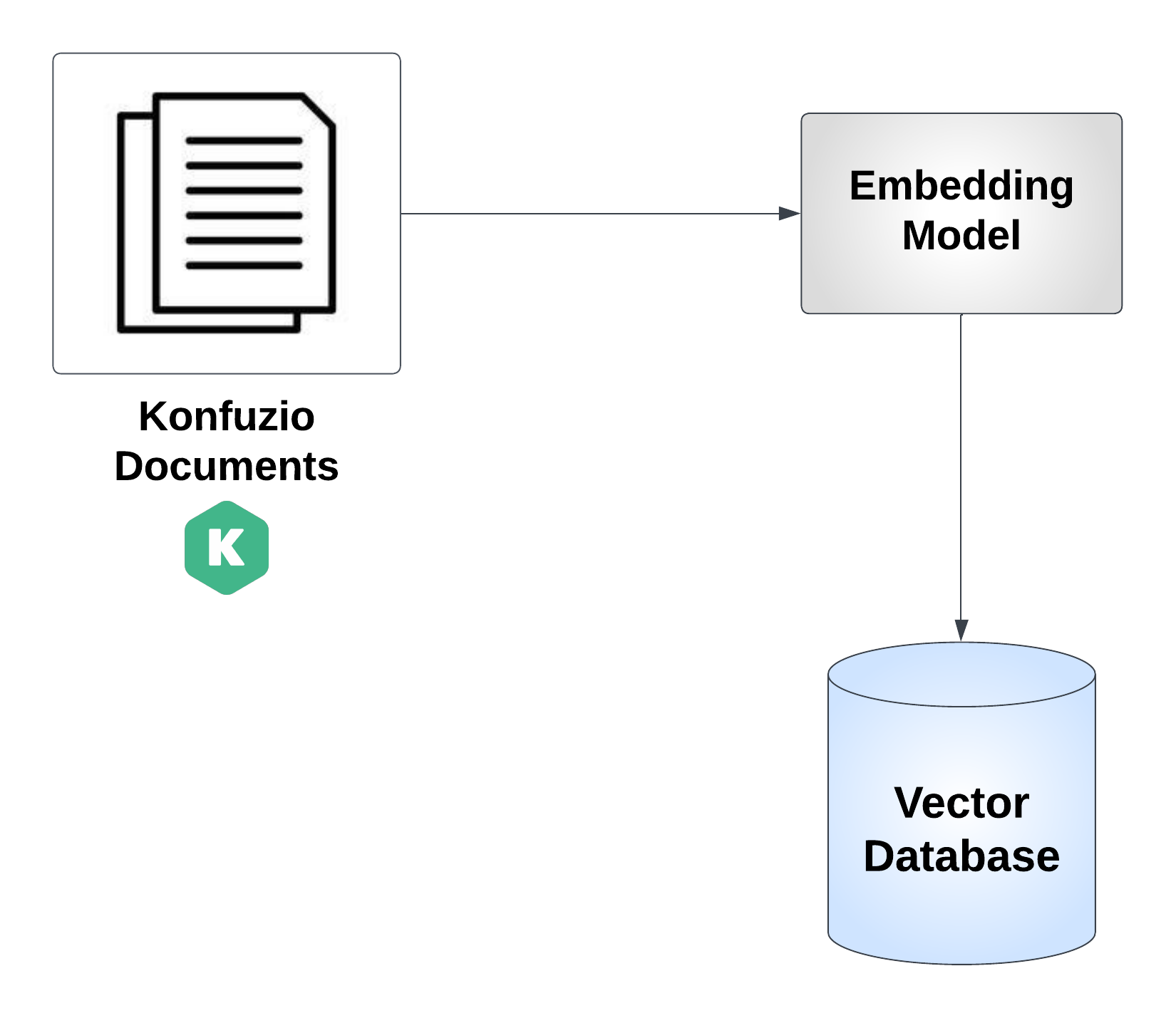
The first step in implementing RAG is to create a Vector database from your domain-specific proprietary data. This database serves as the source of knowledge that RAG draws from to provide contextually relevant answers. To create this vector database, perform the following steps: - Conversion to vectors (embeddings):
To make your domain-specific data usable by RAG, you need to convert it into mathematical vectors. This conversion process is achieved by running your data through an embedding model, which is a special kind of Large Language Model (LLM). These embedding models are capable of converting various types of data, including text, images, video, or audio, into arrays or groups of numeric values. Importantly, these numeric values reflect the meaning of the input text, much like another person understands the essence of the text when they speak it aloud. - Creation of vector databases:
Once you have obtained the vectors that represent your domain-specific data, you create a vector database. This database serves as a repository for semantically rich information encoded in the form of vectors. In this database, RAG searches for semantically similar elements based on the numerical representations of the stored data.
The following diagram illustrates how to create a vector database from your domain-specific proprietary data. To create your vector database, you convert your data to vectors by running it through an embedding model. In the following example, we convert Konfuzio documents (Konfuzio Documents) that contain the latest information about Konfuzio. The data can consist of text, images, videos or audios:
Integrate expertise with Konfuzio
Now that you have built a vector database with domain-specific knowledge, the next step is to integrate this knowledge into LLMs. This integration is done through a so-called "context window".
Think of the context window as the LLM's field of view at a given time:
RAG extends an LLM with domain-specific knowledge from databases and the latest information from the Internet.
This context window allows the LLM to access and integrate important data. This ensures that its responses are not only coherent, but also contextually correct.
By embedding domain-specific knowledge into the context window of the LLM, RAG increases the quality of the generated answers. RAG enables the LLM to draw on the extensive data stored in the vector database. This makes its responses more informed and relevant to the user's queries.
In the diagram below, we illustrate how RAG works using "Konfuzio Documents" as an example:
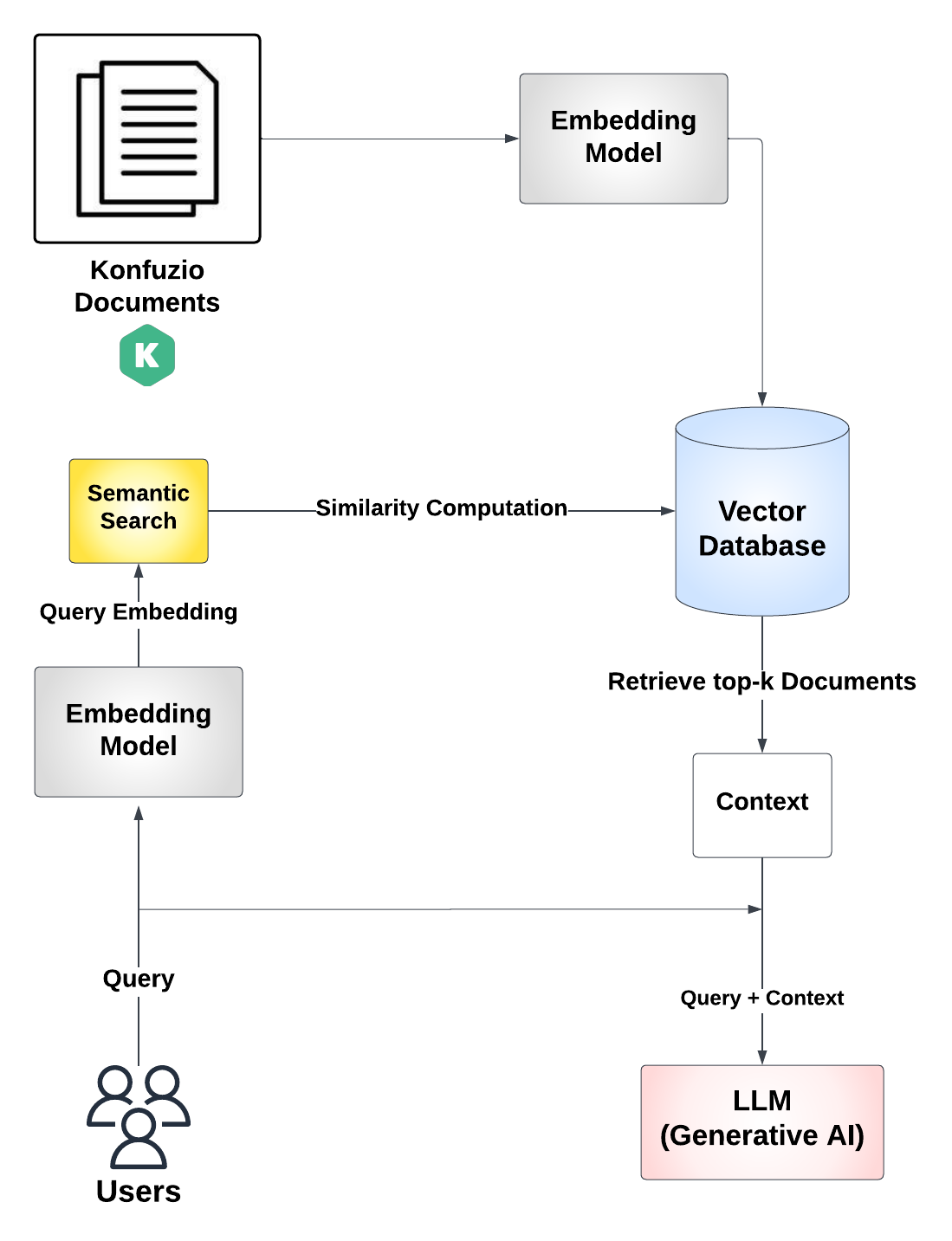
With the help of our RAG workflow, we can make our Large Language Model (Generator) adhere to reliable and already verified content from your knowledge repositories. This way, user requests receive relevant information from valid sources.
Et voilà, the result: Retrieval Augmented Generation
RAG Update
In addition to standard OCR, the structure in documents can be Markdown are represented. This means that even non multimodal LLMsThe Markdown function allows users who work exclusively with text to better understand the content presented in the form of headings, lists, tables and continuous text. This in turn means that you can use Konfuzio Markdown to make your documents easier for the LLM to understand.
Markdown can improve the accuracy and performance of your RAG pipeline!
The reason for this is that this Markdown representation provides more information and context about the documents than before - in the form of tables, figures, checkboxes, etc.
Retrieval Augmented Generation Challenges
Retrieval Augmented Generation (RAG) has the potential to significantly transform the way systems process and deliver information. However, developers and organizations face several challenges that can impact the effectiveness of this technology. In the following, the main challenges associated with RAG are explained, followed by a comparison to other approaches, future developments as well as best practices for implementation.
What dimension of information can LLMs understand and process, and what dimension can they not?
At what point LLMs fail to answer questions is something we will explore in more detail in this blog post. We will also show you how real-time information can be added to Large Language Models.
Looking for more information on using LLMs to develop Konfuzio's DocumentGPT? Read the informative blogpost DocumentGPT - Unleash the power of LLMs and learn more.
Limits of LLMs
Language models offer productivity gains and help us with various tasks. But as mentioned earlier, be aware that even AI-powered LLMs have their limitations. These become particularly apparent when
- timely or current information,
- Real-time information,
- private information,
- Domain-specific knowledge,
- Underrepresented knowledge in the training corpus,
- legal aspects and
- linguistic aspects
be requested. For example, ask ChatGPT about the current inflation rate in Germany. You will get - similar to the test above - an answer like this:
"I apologize for the confusion, but as an AI language model, I do not have real-time data or browsing capabilities. My answers are based on information available through September 2021. Therefore, I cannot tell you the current inflation rate in Germany."
This limitation poses a major problem. ChatGPT, like many other LLMs, is unable to provide timely and contextual information that may be critical for making informed decisions.
Cause behind LLM limits
The reason LLMs are "stuck in time" and unable to keep up with the rapidly evolving world is:
ChatGPT's training and information data has a so-called "cut-off point". This means that if you ask ChatGPT about events or developments that occurred after this date, you will receive either
- convincing sounding but completely false information, which is known under the term "hallucination" or
- Unobjective responses with implied recommendations, such as.
"My data only goes up to XXXX, and I do not have access to information about events that took place after that date. If you need information on events after September 2021, I recommend accessing current news sources or search engines to follow the latest developments."
Retrieval augmented generation for company data
This is precisely where Retrieval Augmented Generation (RAG) comes in. This approach closes the knowledge gap of LLMs and enables them to provide contextually accurate and up-to-date information by integrating external retrieval mechanisms. In the following sections, we explain the concept of RAG in more detail and examine how RAG extends the boundaries of LLMs.
The main difference between RAG and fine-tuning lies in their functionality and purpose. RAG focuses on improving natural language processing by integrating external information, enabling the model to better understand the context of queries and generate more accurate answers. Finetuning, on the other hand, aims to customize a pre-trained base model for a specific task or domain by drawing on a limited amount of training data.
Both methods are useful, but they have different application areas and goals. RAG extends the capabilities of LLMs by integrating external information, while fine-tuning aims at customization for specific tasks or domains.
Data quality and relevance
One of the biggest challenges in the implementation of RAG is the Data quality and relevance . For a RAG system to provide effective and precise answers, it is essential that the underlying data is accurate, up-to-date and relevant.
Data sources
Choosing the right data sources is crucial. Information that comes from outdated, inaccurate or irrelevant sources can lead to incorrect or confusing answers.
Preprocessing
Another aspect of data quality is the pre-processing of the data. Unstructured or poorly formatted information can impair the efficiency of the retrieval and generation process.
The quality of the data is synonymous with the quality of the answers that a RAG system can provide.
Latency problems and key performance indicators
Latency problems are another obstacle to the effective use of RAG. The time it takes to retrieve and process relevant information can affect the user experience.
Responsiveness
Users generally expect immediate responses. If latency is high, the system can be perceived as unreliable or inefficient.
Key performance indicators
It is crucial to define appropriate metrics to evaluate the performance of a RAG system. These metrics should consider not only the accuracy of responses, but also the latency and effectiveness of retrieval.
High latency can significantly impair user satisfaction and reduce acceptance of the system.
Ambiguity in requests
Another significant problem that occurs in RAG systems is the Ambiguity in requests . Users often ask in unclear or ambiguous terms, which means that the system has difficulty understanding the intention.
Context dependency
The ability to interpret contexts correctly is crucial for the relevance of the answers retrieved.
Natural Language Processing
Advances in natural language processing can help to minimize these ambiguities, but are not always error-free.
"Ambiguity in queries is a particular challenge for RAG systems as it can affect the accuracy and relevance of responses."
Comparative approaches
In the world of artificial intelligence, there are different approaches to answering queries and processing information. Two prominent methods are retrieval augmented generation (RAG) and the classic fine-tuning of models.
RAG versus fine-tuning methods
The comparison between RAG and fine-tuning methods highlights the differences in the strategy and results of the two approaches.
RAG enables models to retrieve information from external sources to better understand the context of user queries and generate more accurate responses. It extends the capabilities of LLMs by connecting to knowledge bases or other information sources.
RAG offers a more dynamic and flexible approach than fine-tuning, as it relies on the continuous retrieval of up-to-date information.
Finetuning is a process in which an already pre-trained base model, such as a Large Language Model, is adapted to specific tasks or domains. This is done by further training the model on a limited set of task-specific training data. During the fine-tuning process, the model learns how best to focus on a specific task or domain and optimizes its capabilities for that particular application.
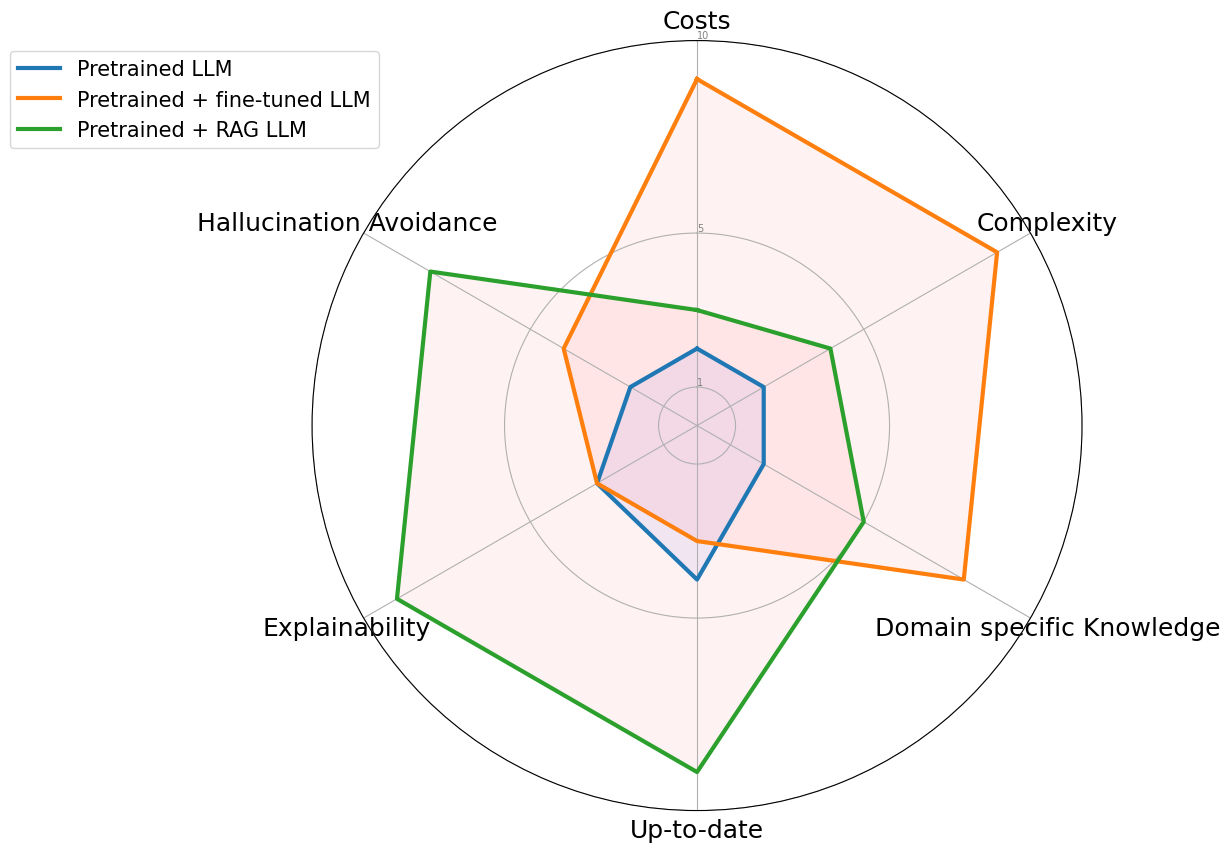
RAG essentially enables large language models to directly access specific data when responding to certain prompts. To illustrate the differences between RAG and alternatives, consider the following figure.
Specifically, the radar chart compares three different methods:
- Pretrained LLM,
- Pretrained + finetuned LLM and
- Pretrained + RAG LLM.
This radar chart is a graphical representation of multidimensional data in which each method is evaluated against several criteria, shown as axes on the chart. The criteria include
- Cost,
- Complexity,
- Domain-specific knowledge,
- Actuality,
- Explainability and
- Avoidance of hallucinations.
Each method is represented as a polygon in the diagram, with the vertices of the polygon corresponding to the values of these criteria for that method.
For example:
The Pretrained LLM method has relatively low values for "Cost", "Complexity", "Domain Specific Knowledge", and "Hallucination Avoidance", but a higher value for "Timeliness" and "Explainability".
The "Pretrained + finetuned LLM" method, on the other hand, has higher values for "Cost", "Complexity", "Domain specific knowledge" and "Hallucination avoidance", but lower values for "Timeliness" and "Explainability". Finally, the "Pretrained + RAG LLM" method has a unique pattern with high values for "Up-to-date", "Explainability" and "Domain specific Knowledge".
The Pretrained + RAG LLM method is characterized by domain-specific knowledge, up-to-date information, explainability, and avoidance of hallucinations. This is probably due to the fact that the RAG approach allows the model to explain information using graph structures, which can improve its understanding, prevent hallucinations, and provide more transparent and accurate answers in specific domains.
Evaluation of performance compared to traditional models
When evaluating the performance of RAG systems compared to traditional models, it is important to consider several factors.
Accuracy
RAG can often provide more accurate and relevant answers because it draws on a broader information base.
Real-time data
RAG models can access new data in real time, which gives them a clear advantage over static models.
RAG's ability to access relevant data in real time is a significant advantage over traditional models.
Future developments
The future of RAG looks promising, especially in terms of technological advances and integration with other AI systems.
Technological advances
Technological developments will further improve RAG systems and expand their range of applications.
Innovations in AI
Advances in natural language processing and machine learning will increase the efficiency and accuracy of RAG models.
Optimization of the algorithms
Innovative algorithms for data retrieval and processing can increase the performance of RAG systems.
Conclusion
The increasing integration of Large Language Models (LLMs) into our daily lives has undoubtedly brought many benefits, but it also has its limitations. The challenge is that LLMs, such as GPT-3, GPT-4, Llama 2, and Mistral-7B, have difficulty in providing timely, contextual information as well as domain-specific knowledge. This presents a significant obstacle, especially when accurate and relevant responses are required.
Retrieval Augmented Generation (RAG) is proving to be a promising solution in this regard. RAG enables the integration of external retrieval systems with large language models, allowing these models to access extensive knowledge bases and up-to-date information. This allows them to better understand user-defined queries and provide more precise, contextual answers.
So why would you use RAG and not rely on alternative approaches?
- RAG enables the provision of real-time information and up-to-date knowledge, which is especially critical in fast-moving fields and for making informed decisions.
- RAG allows the integration of domain-specific knowledge into the answer generation. This is essential when specialized knowledge is required.
- Unlike some alternative approaches, RAG provides a more transparent and traceable method for answering questions because it is based on existing data and facts.
- RAG minimizes the likelihood of false or fabricated information by accessing external, reliable sources.
In summary, Retrieval Augmented Generation fills the gaps in the capabilities of LLMs and enables reliable answers to complex questions. This makes it a promising method for the future of machine intelligence communication and support in a wide range of applications.
Do you have any questions or are you interested in a demonstration of the Konfuzio Infrastructure?
Write us a message. Our team of experts will be happy to advise you.

 EN
EN  DE
DE  ES
ES  FR
FR