
Fast processing of requests and round-the-clock support. This is what customers expect these days and what makes a good service. As a result, it is essential for companies to quickly understand their customers' intentions and respond accordingly in order to provide a service that is characterized by digital transformation competitive environment.
Although a full inbox often leads to frustration, traditional email communication remains in high demand. It is remarkable that over 3 billion business emails are sent and received worldwide every day - and the trend is rising - according to the results of a representative Study by Statista:
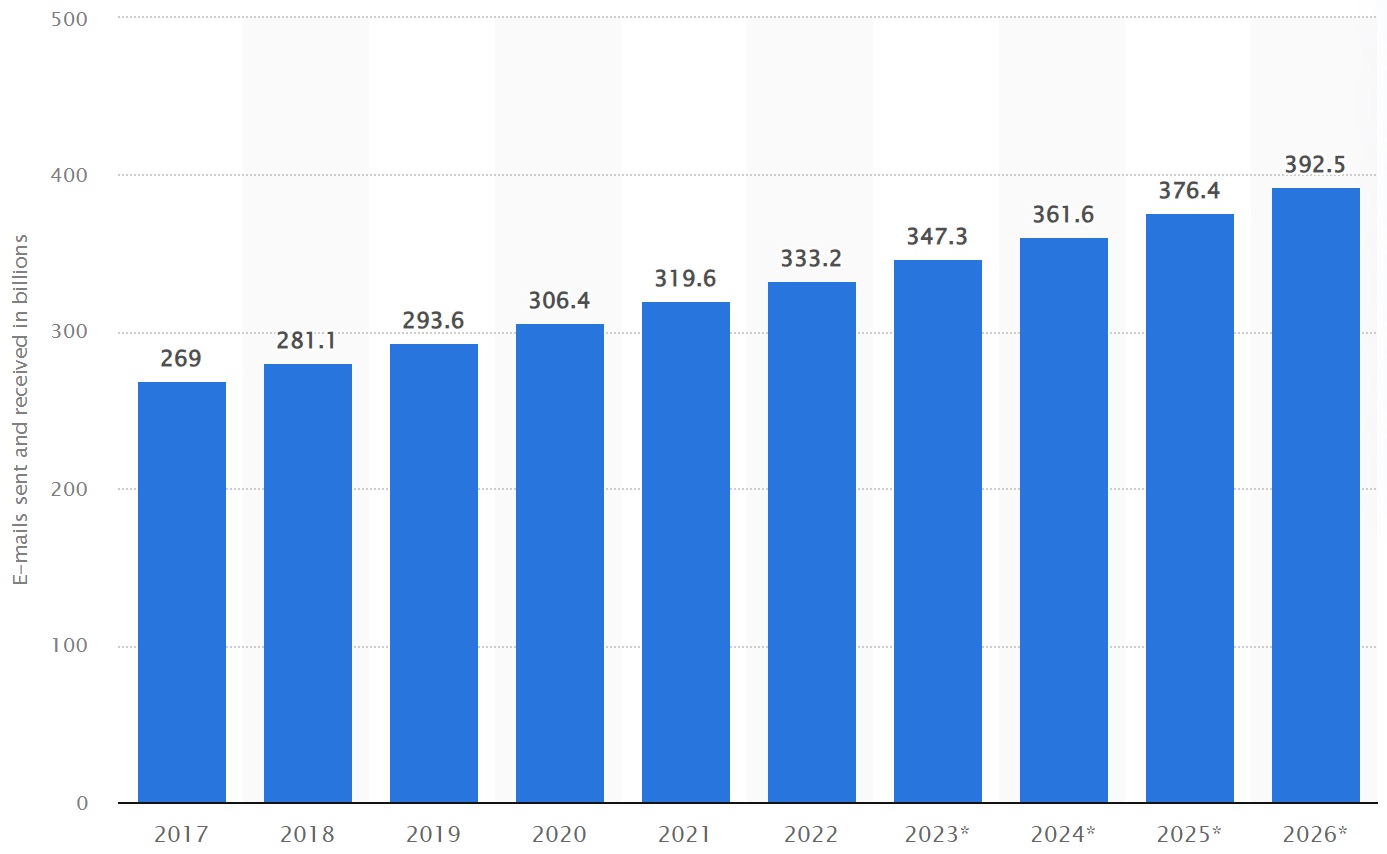
But how can you keep track of this flood and ensure that every email is processed carefully and promptly? The answer lies in email classification - an advanced technology that has claimed the management of email correspondence as its own.
With Konfuzio, we offer an innovative solution that not only saves time, but also increases efficiency and customer satisfaction.
What is Email Classification?
Email Classification automatically assigns incoming emails to predefined categories. The AI analyzes the subject, message text, attachments and sender information to understand the purpose of the message. Based on this analysis, the message is automatically forwarded to the relevant department or person.
In contrast to classic filter rules („IF subject contains ‚invoice‘ THEN forwarding to accounting“), GenAI-based email classification understands the semantic context. An email with the subject „Question about your invoice from 15.03.“ is correctly classified as a customer inquiry, not automatically assigned to accounting.

The paradigm shift: from rule systems to GenAI
Traditional e-mail filtering:
WENN Betreff enthält "Rechnung"
UND Absender-Domain = bekannter_lieferant
DANN Weiterleitung: Buchhaltung
WENN Betreff enthält "Beschwerde" ODER "Problem"
DANN Weiterleitung: Kundensupport
Problem: With hundreds of possible request variants, rule sets become unmanageable. „I have a question about your billing“ is not recognized, even though it is an invoice inquiry. Each new type of query requires manual rule adjustments.
Konfuzio GenAI for Email Classification:
Feld: emailCategory
Typ: Text
Prompt: "Klassifiziere die E-Mail-Anfrage für das Routing.
KUNDENANFRAGE_PRODUKT:
- Fragen zu Produktfunktionen, Verfügbarkeit, Kompatibilität
- Routing: Produktberatung, Vertrieb
KUNDENANFRAGE_RECHNUNG:
- Fragen zu Rechnungsbeträgen, Zahlungsmodalitäten, Gutschriften
- Unterscheide von reinen Rechnungen (ohne Anfrage)
- Routing: Kundenservice + Buchhaltung CC
TECHNISCHER_SUPPORT:
- Fehlermeldungen, Funktionsstörungen, Installationsprobleme
- Routing: Technical Support (Priorität nach Schweregrad)
BESCHWERDE:
- Unzufriedenheit mit Produkt, Service oder Abwicklung
- Routing: Kundensupport (hohe Priorität), Management CC bei Eskalation
VERTRAGSANFRAGE:
- Angebote, Vertragsverhandlungen, Rahmenvereinbarungen
- Routing: Sales, bei Volumen >100k EUR zusätzlich Key Account Manager
BEWERBUNG:
- Initiativbewerbungen, Stelleninteresse
- Routing: HR
Wähle die dominante Kategorie. Bei Mischformen: Primärkategorie + Notiz."
Advantage: Works for all request variants without rule maintenance. „I disagree with the billing“ is correctly classified as a COMPLAINT, not an invoice request, because the AI understands the emotional context.
Concrete implementation: Customer service inbox
Schema definition for e-mail processing:
FELDNAME                  TYP           BESCHREIBUNG
────────────────────────────────────────────────────────────────
emailCategory             Text          Hauptkategorie (siehe oben)
urgencyLevel             Text          Dringlichkeit (LOW/MEDIUM/HIGH/CRITICAL)
customerIntent           Text          Primäres Kundenanliegen in einem Satz
extractedOrderNumber     Text          Bestellnummer falls erwähnt
extractedInvoiceNumber   Text          Rechnungsnummer falls erwähnt
extractedProductName     Text          Produktbezeichnung falls erwähnt
sentimentScore           Number        Sentiment -1 (negativ) bis +1 (positiv)
suggestedResponse        Text          Empfohlener Antwort-Template
Example: Urgency detection
Feld: urgencyLevel
Typ: Text
Prompt: "Bestimme die Dringlichkeit der E-Mail-Anfrage.
CRITICAL (Antwort innerhalb 2 Stunden):
- Produktionsausfall, Systemstörung mit Business-Impact
- Drohende Vertragskündigung, rechtliche Fristsetzung
- Sicherheitsvorfälle, Datenschutzverletzungen
HIGH (Antwort innerhalb 4 Stunden):
- Dringende Kundenanfragen mit Zeitdruck
- Eskalierte Beschwerden
- Angebotsanfragen mit kurzem Entscheidungszeitraum
MEDIUM (Antwort innerhalb 24 Stunden):
- Standardanfragen zu Produkten, Preisen, Verfügbarkeit
- Allgemeine Supportfragen ohne akuten Handlungsdruck
LOW (Antwort innerhalb 48 Stunden):
- Informationsanfragen ohne Zeitdruck
- Newsletter-Anfragen, allgemeine Unternehmensinformationen
Achte auf Signalwörter: 'dringend', 'sofort', 'Frist', 'Deadline',
'nicht funktioniert', 'Ausfall'. Wähle im Zweifel höhere Dringlichkeit."
Example: Sentiment analysis for escalation detection
Feld: sentimentScore
Typ: Number
Prompt: "Bewerte das Sentiment der E-Mail auf einer Skala von -1 bis +1.
+1: Sehr positiv (Lob, Dank, Zufriedenheit)
+0.5: Positiv (freundliche Anfrage, konstruktives Feedback)
0: Neutral (sachliche Informationsanfrage)
-0.5: Leicht negativ (Unzufriedenheit, höfliche Kritik)
-1: Sehr negativ (Verärgerung, Drohungen, scharfe Beschwerden)
Achte auf:
- Emotionale Sprache ('enttäuscht', 'verärgert', 'unverschämt')
- Drohungen ('Anwalt einschalten', 'öffentlich machen')
- Wiederholungen vorheriger ungelöster Probleme
- Großschreibung, Ausrufezeichen
Beispiel: 'Ich bin äußerst verärgert über Ihre mangelhafte Bearbeitung!!!' = -0.9
Beispiel: 'Vielen Dank für die schnelle Hilfe' = +0.8"
Workflow routing with escalation logic:
Feld: workflowRouting
Typ: Text
Prompt: "Bestimme das Workflow-Routing basierend auf Kategorie, Dringlichkeit, Sentiment.
WORKFLOW_STANDARD_SUPPORT:
- Kategorie: KUNDENANFRAGE_PRODUKT, TECHNISCHER_SUPPORT (non-critical)
- Urgency: LOW, MEDIUM
- Sentiment: >= -0.3
- Automatische Zuweisung an verfügbaren Support-Mitarbeiter
WORKFLOW_PRIORITY_SUPPORT:
- Urgency: HIGH oder CRITICAL
- Sentiment: < -0.5
- Kategorie: BESCHWERDE
- Zuweisung: Senior Support Agent, Manager CC
WORKFLOW_SALES_OPPORTUNITY:
- Kategorie: VERTRAGSANFRAGE, KUNDENANFRAGE_PRODUKT mit Kaufabsicht
- Routing: Sales Team (automatische Lead-Erstellung im CRM)
WORKFLOW_ESCALATION:
- Sentiment: < -0.7 (sehr negativ)
- ODER: Wiederholte Anfrage zu ungelöstem Ticket
- ODER: Urgency CRITICAL + Kategorie BESCHWERDE
- Routing: Customer Success Manager, Abteilungsleiter CC, SLA 2h
Wähle einen Workflow, begründe in einem Satz."
API response with workflow trigger:
{
  "emailId": "email-2025-04-15-00847",
  "receivedAt": "2025-04-15T09:23:17Z",
  "from": "kunde@example.com",
  "subject": "Erneute Beschwerde - Rechnung Nr. 2025-0412 immer noch falsch!",
  "extractedFields": {
    "emailCategory": {
      "value": "BESCHWERDE",
      "confidence": 0.96
    },
    "urgencyLevel": {
      "value": "HIGH",
      "reason": "Wiederholte Beschwerde, Ausrufezeichen, Wort 'erneut' signalisiert Eskalation",
      "confidence": 0.94
    },
    "customerIntent": {
      "value": "Kunde beschwert sich über fortbestehend fehlerhafte Rechnungsstellung trotz vorheriger Reklamation",
      "confidence": 0.92
    },
    "extractedInvoiceNumber": {
      "value": "2025-0412",
      "confidence": 0.99
    },
    "sentimentScore": {
      "value": -0.85,
      "indicators": ["erneute", "immer noch falsch", "Ausrufezeichen"],
      "confidence": 0.91
    }
  },
  "workflowRouting": {
    "workflow": "WORKFLOW_ESCALATION",
    "reason": "Sentiment -0.85 unter Schwelle -0.7, Signalwort 'erneute' deutet auf ungelöstes Vorproblem, Urgency HIGH",
    "priority": "HIGH",
    "assignTo": ["customer-success-manager", "head-of-support"],
    "sla": "2 hours",
    "actions": [
      "Suche vorherige Tickets zu Rechnung 2025-0412",
      "Prüfe Rechnungshistorie im ERP",
      "Template ESKALATION_ENTSCHULDIGUNG vorbereiten"
    ]
  },
  "suggestedResponse": "TEMPLATE_ESCALATION_APOLOGY",
  "metadata": {
    "previousTickets": ["TICKET-2025-0301", "TICKET-2025-0328"],
    "customerSegment": "Premium",
    "lifetimeValue": 45000
  }
}
The CRM or ticket system integration processes this response automatically. With "workflow": "WORKFLOW_ESCALATION" a high-priority ticket is created, the Customer Success Manager receives a notification immediately, the system automatically loads the previous tickets and the affected invoice from the ERP. The employee can see at a glance: Repeated complaint, very negative sentiment, premium customer, 2-hour SLA.
Advantages of Email Classification
Measurable time savings
A customer service team with 50,000 emails per month saves an average of 30 seconds per email through automated classification (manual categorization is no longer necessary). This corresponds to 416 working hours per month, which are used for qualified customer advice instead of administration.
Accelerated response times
Automatic routing eliminates waiting times in general mailboxes. Instead of a technical inquiry first ending up in the sales mailbox, waiting two hours and then being forwarded manually, it reaches the right expert immediately. Average first-response time drops from 8 hours to less than 2 hours.
Escalation prevention through sentiment detection
Negative sentiment scores automatically trigger priority routing. A disgruntled complaint does not end up in the standard queue, but rather immediately with Senior Support. This measurably reduces the escalation rate, as frustrated customers are not made even more frustrated by slow standard processes.
Strategic insights through classification analytics
After three months, the evaluation shows: 35 percent of all emails are CUSTOMER INQUIRY_INVOICE. This indicates a need for optimization in invoice communication. A dashboard shows: sentiment score for product category „XY“ averages -0.4, for other products +0.2. Clear indication of product quality problems.
Integration into existing systems
Konfuzio Email Classification delivers structured JSON outputs that flow directly into CRM (Salesforce, HubSpot), ticket systems (Zendesk, Jira Service Management) or ERP systems. Not a separate tool, but intelligent pre-processing for existing workflows.
Why Konfuzio for Email Classification?
Konfuzio combines three decisive advantages:
GenAI precision without template maintenanceWhile classic e-mail filtering requires hundreds of rules, with Konfuzio you define in natural language what is to be classified. New request types are immediately recognized correctly.
On-premise & GDPR-compliantYour emails remain in your infrastructure. No data transfer to external cloud services. Complete control over sensitive customer communication.
Seamless integrationREST API enables connection to any email system (Exchange, Gmail, Outlook) and any workflow (Zapier, Power Automate, direct ticket system integration). Implementation in days, not months.
The combination of semantic understanding (correctly categorizes „I am dissatisfied with the billing“ as a complaint), data sovereignty and integration capability makes Konfuzio the enterprise solution for email processing.
Applications
Konfuzio Email Classification can be used across all industries. Here are three exemplary use cases:
InsuranceIncoming damage reports are classified according to damage type (liability/casco/household contents), urgency and completeness of information. Incomplete reports automatically trigger demand templates. Complete reports with a high claim amount are immediately routed to senior claims handlers.
BanksCredit requests by e-mail are classified according to credit type, creditworthiness indicators in the request and completeness. The system extracts the desired loan amount and purpose and forwards the request to the responsible advisor. Automatic escalation to corporate customer area for large loans.
E-commerceReturn requests are classified according to the reason for return (faulty/wrong size/wrong delivery), sentiment and customer history. Premium customers with negative sentiment receive an immediate call-back service. Standard returns receive an automatically generated returns bill.
You can find further industry-specific applications in our specialist articles on AI in administration, Digitization in banks and intelligent document processing in logistics.
Conclusion
With over 3 billion business emails sent worldwide every day, intelligent email classification is not a nice-to-have, but a competitive advantage. Konfuzio enables automated classification, sentiment recognition and context-dependent routing without time-consuming rule maintenance.
The difference to five years ago: No more rigid filter rules, no IT dependency for new query types, no weeks of implementation. Departments define what is to be classified in natural language and GenAI takes care of the implementation.
The next stage of development: automatic response generation for standard inquiries, proactive escalation prevention through trend analysis, multi-channel integration (e-mail, chat, social media) in a standardized classification system.
Contact
Would you like to automate your digital inbox intelligently and achieve measurable efficiency gains? Our experts will show you in a live demo how Konfuzio Email Classification works in your existing IT infrastructure.

 EN
 DE
 ES
 FR